The “IE User Low IQ Study” Hoax and the “Creation” of News

You may have read about it and even posted it on social networks and media – “Users of Microsoft’s Internet Explorer Web Browser have a Lower-than-average IQ”. This has turned out to be a hoax.

A website called AptiQuant.com published a report on how a study has revealed that IE users have lower-than-average IQ. This, quite understandably, enraged numerous IE users, and hate mail & threats of litigation against AptiQuant followed.
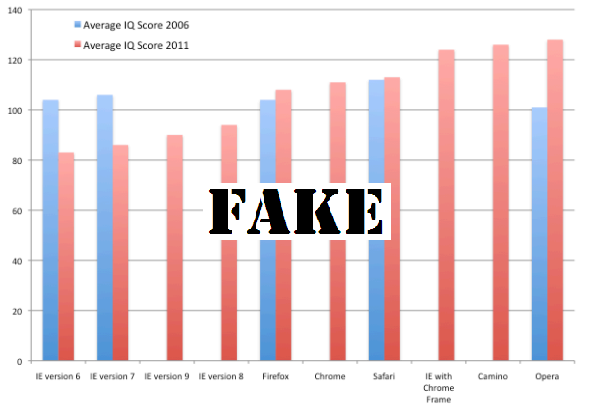
Later, uncanny similarities between AptiQuant.com and CentralTest.co.uk sites were discovered, which led to the veracity of the study and the site itself being questioned. Eventually, the site admitted to the hoax, and apologized to CentralTest for using their website materials, including the same “Our Team” people with different, imaginary names!

Continue reading →

Thus Begins the Slide

Global markets are on a downward slide. Stock markets across the globe are either falling sharply (indices in New York, London, Paris & Frankfurt are falling sharply as of writing this piece), or have closed lower (indices in Japan & Hong Kong).

Meanwhile, Spanish and Italian long-term bonds are yielding their record highest – indicating a lack of faith in their sovereign debt by creditors. Also, gold prices have hit a record high, being considered the lone safe investment now.

Having woken up from the keen focus on the US debt limit issue, global markets are now focusing on the general health of the global economy. The poor health of the US economy (slow service sector growth and falling factory order statistics being indicative), the ‘unbailably’ large economies of Spain and Italy, unrest  & uncertainty in the Middle Eastern nations – are all compounding the concerns of investors and markets across the globe.

Meanwhile, credit rating agencies Moody’s and Fitch have maintained their AAA rating for the US, albeit with a negative outlook on the ratings. The harsher S&P has not yet released their ratings. On the other hand, Dagong Global Credit Rating Company, China’s leading credit rating agency, has downgraded the US to A from A+ (which was, itself, a downgrade in Nov 2010). With the “Big Three” raters coming into frequent criticisms recently, rating agencies from developing economies are now gaining a stronger voice.

Overall, all these developments are signs of tougher times to come.

US Debt Brinkmanship – The Global Financial/ Political Chicken Game

The Republican-controlled US Congress, the Democrat-controlled US Senate and the US President Barack Obama are playing a deadly “chicken” game with the issues regarding the US debt ceiling increase, tax raises and spending cuts.

The Republicans want to force the Democrats’ hands in not letting taxes be increased while initiating spending cuts; meanwhile the Democrats have declared dead-in-the-water any proposal that does exactly that. Neither House Speaker John Boehner (Rep) nor President Obama (Dem) has yet managed to find a middle ground acceptable to all parties.

With the August 2 deadline for raising the US debt ceiling or risking credit default looming, either party has to “swerve” or crash horribly into each other. This would have catastrophic consequences for both the US and the global economy.

Continue reading →

Aliyun OS – New Kid on the OS Block

Global e-commerce giant Alibaba has just unveiled its new mobile device operating system – Aliyun OS. It has been developed by Alibaba Cloud Computing, a subsidiary of the Alibaba Group. It has been introduced as a cloud-based operating system, featuring cloud services including e-mail, Internet search, weather updates, mapping & GPS navigation tools.

The cloud OS provides support for web-based apps as well, offering users an Internet-like experience that do not require the user to download or install application software on their mobile devices. Cloud OS users will be able to synchronize, store and back-up data such as contact information, call logs, text messages, notes and photos to the cloud and also access & update this data across all their PC and mobile devices.

Continue reading →

The Big Mac Index gets Garnished

The Economist just released an updated version of their Big Mac Index, having run a “best fit” regression line against GDP per person (the line does visibly appear to be a significant fit). A nice, novel metric, based on a measure referencing a good that may not be in the typical consumption basket across all economies.

“Currency Comparisons, To Go” from The Economist

Euro-Zone Bail-out: Media & Market Reactions

Greece has been bailed out. A number of steps have been initiated by the leaders in Europe. A modicum of stability has returned to the Euro-zone financial (and political) system.

Specific to Greece, euro-zone official lenders’ debts have been restructured in the forms of lowering interest rates from 5.5% to approx. 3.5% and extension of term from7.5 years to 15 or even 30 years. These have been backed by €109 billion bail-out money, an additional €20 billion for Greek bond buyback and €35 billion ECB collateral for Greek banks. Private creditors, officially recognized as Private-Sector Involvement (PSI) have been given a choice of either of three options – rollover of maturing bonds, swap with longer maturities (both backed by AAA  -rated collateral) or secondary market bond buybacks. However, the PSI has been defined to include only ‘voluntary’ and ‘substantial’ creditors, which would lead to a number of lenders being short-changed.

Continue reading →